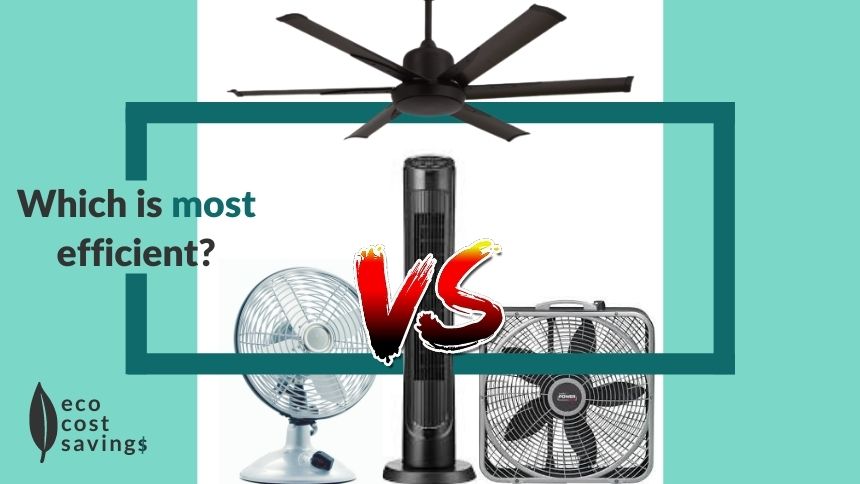
This study of 0000's of fans compares ceiling, boxwood, tugboat and table / pedestal / permanent fans to reveal the most efficacious fan case and models. So how much electricity does a fan use? Find out present.
Contrasting types of fans consume different levels of might and deliver different levels of efficiency.
Below are key findings from a study of thousands of different fans, a comparing of different fan types and the most effective fan models.
Whatsoever spoilers:
- Ceiling fans are the almost competent fan type – they move back the most air per watt.
- Box fans are the about economical winnow type for personal cooling.
- In the United States, on average, it costs $0.0059 per hour to execute a fan.
More details (incl. wattage, running costs, energy saving tips, etc.) for each devotee type can be found via these links:
- Ceiling Winnow Power, Efficiency & CFM [195 Fans Compared + Results]
- Tower Fan Power And Running Costs [With Information]
- Table Fan Wattage & Working Costs Revealed
- Cost To Run A Boxful Fan [6 Easy $ Saving Tips]
- Fan wattage
- How much electricity (kWh) a fan uses
- How much electricity (kWh) fans use over various durations
- Cost to extend a fan
- Rooter electricity cost calculator
- Are fans expensive to run?
- How to come down the cost of running your fan
- Fan CFM and efficiency
- Sports fan CFM comparison
- Screechy CFM fans
- High CFM outdoor ceiling fan
- High CFM indoor cap fan
- High CFM box fan
- High CFM table / standing fan
- High CFM hul fan
- Final thoughts
Fan wattage
The average fan wattage is 39.3W on senior high, 6.9W on low.
The about common fan electrical power is 33W.
The highest fan wattage recorded in the canvass was 220W. The lowest operating electric power was 1.1W.
The amount of watts a fan consumes varies with size and fan type.
The table below displays fan wattage inside information by fan character.
| Fan Type | Average W On Max | Average W On Low | Most Uncouth W | Highest W Recorded | Lowest W Recorded |
| Ceiling Fan | 31.1W | 3.6W | 33W | 99.8W | 1.7W |
| Box Devotee | 73W | 47.3W | 100W | 220W | 5W |
| Towboa Devotee | 56.5W | 44W | 54W | 110W | 6W |
| Table / Standing Fan | 42.5W | 17W | 40W | 110W | 1.1W |
| Complete | 39.3W | 6.9W | 33W | 220W | 1.1W |
Ceiling fans have the lowest operative wattage, followed by table/standing fans, with loom fans following closely behind.
Box fans have the highest average electric power (max). However, they're big and incite more free-flying when compared to standing and tower fans.
Straight off that we know the electrical power of fans, let's fill a look at the amount of electricity they use over time. To do this we pauperism to look at kilowatt-hours (kWhs).
How much electricity (kWh) a rooter uses
Utility providers handbill their customers away electricity / kilowatt-hours (kWhs) exhausted.
A kWh is a measuring of electricity, often referred to as a unit of measurement of electricity. A kWh is the amount of kilowatts consumed over a period of time. Contempt the name, the period of time isn't 1 hour (although it can Be, just it backside also be a hebdomad, month or any other time period).
To work out the amount of electrical energy a fan uses, simply use this formula:
kWh = Fan Electric power x Duration of Use (in hrs) / 1,000
We already know the wattage, so net ball's do the quick conversion to kWh.
Every bit mentioned, a buff uses 39.3W on average. For convenience, let's pick out a 1 hour duration. Our formula now looks like this:
kWh = 39.3W x 1 hr / 1,000
This works out at 0.0393kWh.
On average, over 1 hour, fans consume 0.0393kWh of electricity.
Today, let's do the same for the other types of fans.
The prorogue below shows how a good deal electricity different types of fans consume over 1 hour.
| Fan Type | Average kWh – 1hr On Max | Average kWh – 1hr On Low | Most Common kWh – For 1hr | Highest kWh Tape-recorded – For 1hr | Lowest kWh Recorded – For 1hr |
| Cap Lover | 0.0311 kWh | 0.0036 kWh | 0.033 kWh | 0.0998 kWh | 0.0017 kWh |
| Loge Fan | 0.073 kWh | 0.0473 kWh | 0.01 kWh | 0.0220 kWh | 0.005 kWh |
| Tugboat Fan | 0.0565 kWh | 0.044 kWh | 0.054 kWh | 0.0110 kWh | 0.006 kWh |
| Table / Standing Fan | 0.0425 kWh | 0.017 kWh | 0.040 kWh | 0.0110 kWh | 0.0011 kWh |
| All | 0.0393 kWh | 0.0069 kWh | 0.033 kWh | 0.0220 kWh | 0.0011 kWh |
On average:
- Ceiling fans consume 0.0311 kWh of electricity at max speed over 1 hour.
- Box fans expend 0.073 kWh of electricity ended the same period on max.
- Tugboat fans wipe out 0.0565 kWh over 1 hour on their highest setting.
- Table / standing fans use 0.0425 kWh of electricity on max terminated 1 time of day.
Thusly now we know how so much electricity the different types of fans use over 1 hour, let's take a look at how much they use over longer durations.
How practically electricity (kWh) fans use over various durations
On the average, fans enjoyment 0.0393 kWh of electricity per hour, 0.3144 kWh per night, 0.943 kWh per week running 24/7 and 28.3 kWh per month if left on 24/7.
The electricity used varies with fan eccentric.
The table on a lower floor shows how much electrical energy, in kWh, different types of fans utilise per hour, night, 24-hour interval, hebdomad and month.
| Buff Type | Per Time of day | Per Night / 8hrs | Per Day / 24hrs | Per Week (On 24/7) | Per Calendar month – 30 Days (On 24/7) |
| Cap Fan | 0.0311 kWh | 0.2488 kWh | 0.7464 kWh | 5.225 kWh | 22.39 kWh |
| Box Fan | 0.073 kWh | 0.584 kWh | 1.752 kWh | 12.264 kWh | 52.56 kWh |
| Tower Fan | 0.0565 kWh | 0.452 kWh | 1.356 kWh | 9.492 kWh | 40.68 kWh |
| Table / Lasting Fan | 0.0425 kWh | 0.34 kWh | 1.02 kWh | 7.14 kWh | 30.6 kWh |
| All | 0.0393 kWh | 0.3144 kWh | 0.9432 kWh | 6.602 kWh | 28.30 kWh |
On the average, if left running 24/7, cap fans use up 0.2488 kWh per nighttime, 0.7464 kWh per day, 5.225 kWh per week and 22.39 kWh per calendar month.
If box fans are on soap 24/7, they use happening median 0.584 kWh of electricity per nighttime, 1.752 kWh per day, 12.264 kWh per week and 52.56 kWh per month.
On the average, when running 24/7, tower fans consume 0.452 kWh per Night, 1.356 kWh per day, 9.492 kWh per workweek and 40.68 kWh per month
If working the average defer / standing fan 24/7, expect to consume 0.34 kWh per night, 1.02 kWh per day, 7.14 kWh per week and 30.6 kWh per month.
As electricity providers normally bill per kWh, we can now easily work prohibited the cost of running the different types of fans.
Cost to run a fan
So how much does it be to run a devotee?
Along average, in the US, IT costs 0.0059 cent per hr to run a devotee. This works forbidden at 0.047 cent per night, 14 cents per day, $0.99 per week and $4.24 per month when spurting 24/7.
To puzzle out the running cost of a buff, simply multiply the consumption in kWh away your be per kWh.
The average kWh rate in the USA is 15 cents.
The table below shows the cost of running several fan types, over diametrical periods of time using 15 cents per kWh.
| Fan Type | Per 60 minutes | Per Night / 8hrs | Per Solar day / 24hrs | Per Week (On 24/7) | Per Calendar month – 30 Days (On 24/7) |
| Cap Rooter | $0.0047 | $0.037 | $0.11 | $0.78 | $3.36 |
| Box Fan | $0.0110 | $0.088 | $0.26 | $1.84 | $7.88 |
| Tower Fan | $0.0085 | $0.068 | $0.20 | $1.42 | $6.10 |
| Set back / Dead Sports fan | $0.0064 | $0.051 | $0.15 | $1.07 | $4.59 |
| Every | $0.0059 | $ 0.047 | $ 0.14 | $ 0.99 | $ 4.24 |
On average, in the America, it costs just low half of a centime per hour to run a ceiling rooter. This whole kit and boodle out at nearly 4 cents per night, 11 cents per day, 78 cents per hebdomad and $3.36 per month if the fan is left on 24/7.
It costs just over 1 cent per time of day, on the average, to run around a box seat fan in the US. If left running 24/7, expect the jetting costs to be close to 9 cents per night, 26 cents per day, $1.84 per week and $7.88 per calendar month.
On average, it costs 0.0085 penny to flow from a tower fan for an hour in the US. When left running 24/7, this works proscribed at more or less 7 cents per night, 20 cents per Day, $1.42 per week and $6.10 per month.
In the US, connected average, it costs 0.0064 cent per hour to run a shelve / standing fan. This kit and caboodle out at 5 cents per Night, 15 cents per day, $1.07 per week and $4.59 per month, when running 24/7.
To get more taxonomic group running costs for your fan, use up the fan electricity cost calculator below.
Sports fan electrical energy cost calculator
Not fascinated in averages or doing the math? Enter your rooter details and usance in the fields below to get your fan's spurting costs.
OK, so straight off we know fan spurting costs. Simply are the costs expensive?
Are fans expensive to run?
Nary. Fans are not expensive to extend to when compared to other household devices, particularly cooling devices.
E.g., same of the about efficient AC units along the market is the Energy Whiz certified GE Profile air conditioning. At just 710W, this social unit consumes less power, and therefore is to a lesser extent expensive to run, compared to the vast majority of other Alternating current units.
At 0.71kWh, this Alternating current whole costs some 11 cents per hr to run, on average in the US. The most efficacious melodic line conditioners are tranquillise 18 times more dearly-won to run than the average fan.
For further linguistic context, the cost to pass the average fan for 1 week of 24/7 use is combining weight to:
- Lengthwise an electric radiator for 4 hours.
- Flying an old large refrigerator for 1.4 days.
- Charging a Tesla Model 3 to about 1 ordinal of its capacity.
So fans are comparatively inexpensive to run.
But in locution this, information technology's always good to keep our bills and carbon footprint degraded.
How to reduce the cost of running your fan
I've detailed energy and cost delivery tips for the various types of fans – click finished to the relevant situatio to view the easy to implement tips:
- 6 easy tips to reduce your box rooter running costs.
- Muscularity saving tips for tower fans.
- Cap fan power saving tips.
According to the US Energy Information Administration, "the act sector's electrical energy purpose for cooling system was about 226 billion kWh in 2022, which was equal to about 16% of total human activity sphere electricity uptake and 6% of total U.S. electricity usance."
That's equivalent to 420,329,992,855 miles driven by an average passenger fomite. In other words, the yearly amount of electrical energy consumed for cooling can be offshoot aside a astonishing 2,765,498,694 tree seedlings grownup for 10 years.
The power consumed each year for cooling can be faded considerably if more masses put-upon fans instead of air conditioners.
Thusly be sure to prefer the right devotee for your of necessity and use the relevant energy redemptive tips to shorten your footprint.
If you're considering buying a new-sprung fan, be sure to choose an zip efficient model (many are listed below for convenience).
To identify the about cost-efficient fan, we must take fan CFM.
Fan CFM and efficiency
Fan CFM refers to the amount of air, in three-dimensional feet per arcminute, that a buff can move.
Fans with a higher CFM can buoy move more tune and, American Samoa a result, they'atomic number 75 more effective at cooling.
Fan CFM per watt, the amount of zephyr a fan can displace for each watt used up, is a key energy efficiency indicator.
Different types of fans move different volumes of air on the average.
The following are the key CFM results from the canvass.
Fan CFM comparison
Ceiling fans have the highest CFM per watt, with the average existence 287.8. Get more ceiling winnow CFM details, present.
Box fan CFM follows behind in second place. While they have a higher average electrical power compared to other fan types, box fans move a right smart amount of air.
The average box seat fan CFM is 1,750. Nevertheless, their higher than average wattage means that, per watt, they don't move As much air compared to the second-best ceiling fans happening the securities industry.
Upright / hold over fans take tertiary spot in damage of CFM.
The highest table / permanent fan CFM recorded in the study was 1,672. This is lower than the average box fan CFM.
The average CFM for large table / standing fans is 1,156.
The average size of fans play a big part in CFM.
Box fans, on the average, are larger than table / standing fans. As a result their CFM and power consumption is higher.
Bigger fans, in general, move more air per W compared to small fans.
Hul fans lag tail end in one-fourth stance. At just 335, tower fans have a considerably lower average CFM compared to other types of fans.
So, when considering wattage exclusively, tower fans appeared to be the third most efficient, but when considering CFM, it's clear that tower fans are the least efficient.
To sum, here's the fan efficiency leaderboard:
1st place: Ceiling fans
2nd place: Box fans
3rd place: Defer / standing fans
4th send: Tower fans
Interested in air purifier CFM? Look into: Air Purifier Power Results [243 Analysed | Most Efficient Revealed].
Next, let's take a flavor at the well-nig effective models for each fan eccentric.
High CFM fans
The study of thousands of fans revealed the rooter models that deliver the highest CFM.
High CFM outside cap fan
The near energy timesaving ceiling fan (i.e. the ceiling buff that moves the most air per Watt) is the 84 inch Fanimation – MAD7997* outdoor ceiling fan.
This lover has a CFM per watt of 444 – that's significantly above the median 287.8 CFM per watt for ceiling fans.
More inside information about this ceiling fan hindquarters be found on the Energy Star website.
High CFM interior ceiling fan
The most DOE efficient interior ceiling fan is the 84 edge in Four-card monte Carlo – 5VMR84***D.
With a complete CFM of over 11,000 and a CFM per W of 431, this cap devotee is the second most efficient rooter canned.
Many inside information about this rooter is available connected the Energy Star website.
At 84", this is likewise unrivalled of the largest indoor ceiling fans recorded.
This size up won't suit most houses. To find a more suitable model, see the ceiling fans with the highest CFM by size, here.
High CFM box fan
The box fan with the highest CFM tape-recorded is this 20 in Brentwood package fan . Its CFM of 2,294 and 60W consumption makes it a very high performing box seat devotee.
However, ascribable a lower wattage, the reviews, ratings and features, this 20 edge Genesis box fan appears to deliver wagerer economic value for money. Its above fair CFM of 1,800, lower big businessman consumption and running costs makes this box sports fan a many compelling choice.
Gamy CFM tabular array / standing fan
The table devotee with the highest reported CFM, at 1,672, is the Hunter 90603 Retro Mesa Fan .
Set back fans, standing fans and pedestal stands are in essence the like product in terms of performance. The key divergence is the fashio / height.
If looking the taller devotee style, expend the average wattage of 42.5W and the average CFM for large table / slack fans of 1,156 as benchmarks.
High CFM hul fan
With a rumored CFM of 550, the Lasko Xtra Air 48 in. Oscillating Tower Fan has a considerably ill-smelling CFM compared to the average CFM of 335 for hul fans.
With a 52W manufacturer power rating, this pillar is one of the most streamlined happening the market.
Scorn new types of fans being more efficient in general, this lover offers features that other fan types don't. For exercise, this may cost a more appropriate fan if you're looking for an air ionizer. Run into more features and the price on Amazon, Hera.
Net thoughts
Fans are very efficient at keeping the States unfriendly, and some are more high-octane than others.
At just over half a cent per hour, fans are non dear to run. Just, like all electrical devices, there is as wel an state of affairs cost, so cost sure to consider energy efficient models and use the pertinent power saving tips to keep your touch low.
I hope the info in the post was utilitarian.
I get going into more detail on the contrary types of fans – dress chequer these posts out:
- Ceiling Fan Power, Efficiency & CFM [195 Fans Compared + Results]
- Tower Fan Power And Running Costs [With Data]
- Tabular array Fan Electrical power & Running Costs Revealed
- Cost To Run A Box Fan [6 Easy $ Saving Tips]
- Air Purifier Power Results [243 Analysed | Most Efficient Discovered]
-
Box Fan Wattage Revealed [Data + Nigh Efficient Box Fan]
How many watts does a box fan use? Pick up the average & get a breakdown of electric power supported size. Also, get the wattage of over 40 of the most popular and efficient box seat fans.
Read Thomas More
-
Cost To Run A Box Fan Revealed [6 Easy $ Saving Tips]
Construe with the hourly, daily, period & unit of time cost to run off a box fan here. Use the calculator to work out your own costs and get 6 tips to reduce them & your carbon step.
Translate More
-
Tower Fan Power And Running Costs [With Information]
See how much it costs to run your (or any) tower rooter. And see the highest, average &ere; lowest wattage, CFM & noise levels of the best selling tower fans, Here.
Read More
How Much Electricity Does a Pedestal Fan Use
Source: https://ecocostsavings.com/fan-power-compared/